Hexagram 10 Treading (Conduct) — Six in the Third Line Explained

Six in the Third: The one-eyed man thinks he can see, the lame man thinks he can tread. He treads on the tail of the tiger. The tiger bites the man. Misfor...

Yao Position Overview

Yao Text

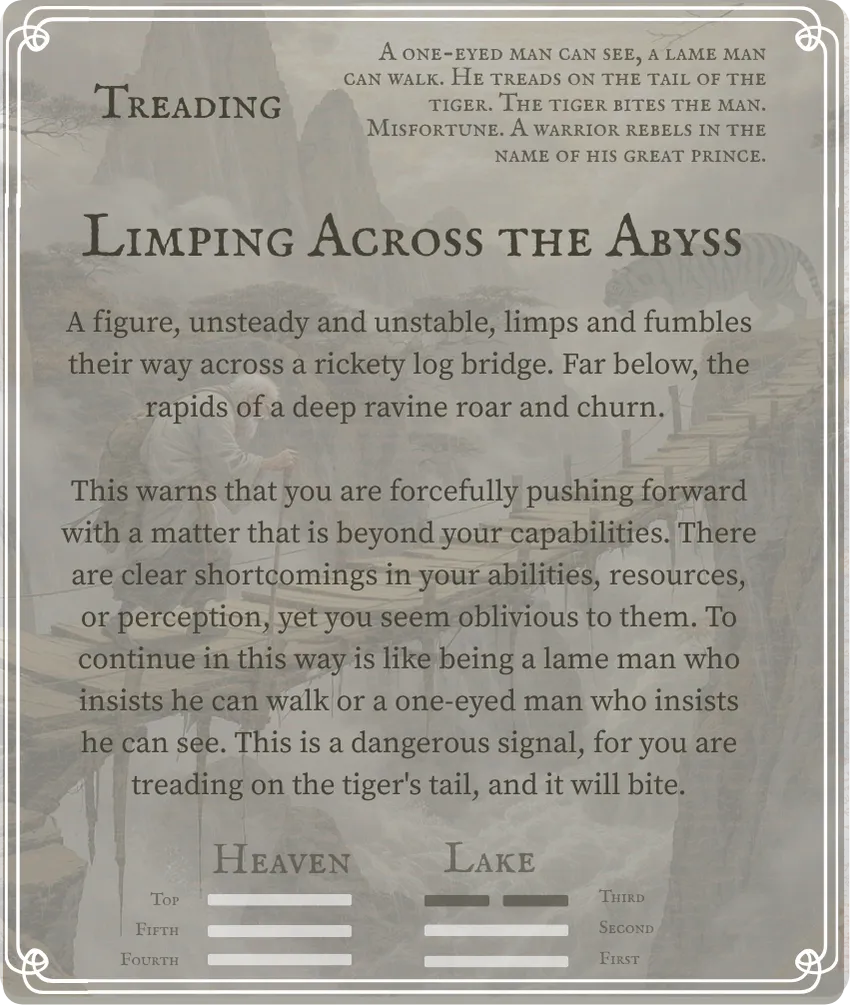
Six in the Third: The one-eyed man thinks he can see, the lame man thinks he can tread. He treads on the tail of the tiger. The tiger bites the man. Misfortune. A warrior acts thus for a great prince.

Tuan Commentary

The Tuan Commentary says: Treading. The soft treads upon the hard. Joyous and responsive to the Creative, therefore 'treading upon the tail of the tiger, which does not bite.' The strong attains the central and correct position and acts without blame. Brilliance is at its height.

Hexagram 10 Treading (Conduct) — Six in the Third Line Card

The Six in the Third is the most dangerous line in Treading. A yin line in a yang position, it represents someone unsuited for the task who nevertheless pushes forward. The one-eyed man and the lame man are powerful images of self-delusion: partial ability mistaken for full competence.

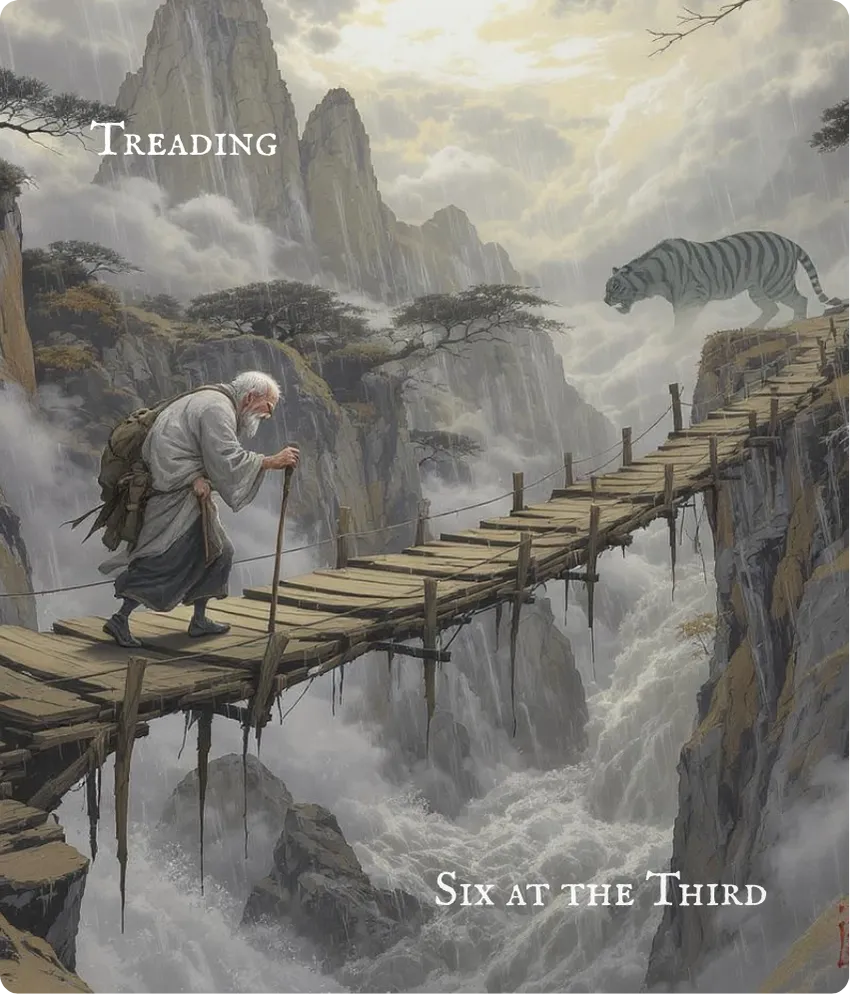
As the card depicts — a figure on a crumbling bridge, limping forward despite every sign of danger. This reckless overconfidence is the tiger's invitation to bite. The line warns that only a warrior acting on behalf of a just cause has any excuse for such bold risk-taking — and even then, it carries the shadow of misfortune.

Yilore Reading

Crossing the Dangerous Bridge

Hexagram 10 Treading (Conduct) — Six in the Third Card Front
Hexagram 10 Treading (Conduct) — Six in the Third Card Back

Yilore interprets the Six in the Third as 'Crossing the Dangerous Bridge.' The card shows a figure on a crumbling, swaying bridge — one eye bandaged, one leg dragging — yet pressing forward with misguided confidence.

This card is perhaps the most vivid warning in the Treading series. The tragedy is not just the danger but the self-delusion: the person genuinely believes they can see clearly and walk steadily. This gap between perceived and actual ability is where disaster lives.

The card's deepest teaching: honest self-assessment is not a luxury but a survival skill. Before you step onto any metaphorical tiger's tail, ask yourself honestly: can I really see clearly? Can I really walk this path? If the answer isn't a firm yes, step back and prepare further.


Divination Insights

The Six in the Third delivers a stark warning: do not overestimate your abilities when facing danger. Self-delusion in the face of real power leads to disaster.

Career

In career, do not attempt challenges far beyond your current capability. The promotion you're not ready for, the confrontation with a vastly more powerful rival, the project beyond your expertise — these are all 'tiger's tails' that will bite. Honestly assess your readiness before taking risks.

Relationships

In love, don't pursue relationships or situations where you lack the emotional maturity or tools to succeed. Rushing into intense emotional territory without the capacity to handle it leads to being 'bitten.'

Wealth

Financially, do not invest in areas you don't understand or take financial risks beyond your capacity to absorb losses. The 'one-eyed man' in finance thinks he sees market patterns clearly but is actually half-blind. Stick to what you genuinely understand.

Health

Health-wise, don't attempt physical challenges beyond your current fitness level. The 'lame man who thinks he can tread' may attempt an extreme workout and injure himself. Be honest about your body's capabilities and build up gradually.

易羅 アプリのアイコン

Get the Yilore app

Full charts, daily hexagrams, and deeper AI readings on your phone.

App Store

FAQ

Why is this the most dangerous line?

Because it combines two deadly elements: real danger (the tiger) and self-delusion (thinking you can see/walk when you can't). Other lines face the tiger with full awareness and proper conduct. The Third line faces it while half-blind and lame but believing itself capable. This gap between perceived and actual ability is where catastrophe occurs.

Who is the 'warrior acting for a great prince'?

The final sentence adds a nuance: the only scenario where such bold, dangerous action might be justified is when a warrior acts on behalf of a righteous leader's cause. Even then, it's described in the context of misfortune — the warrior risks being bitten. The message: only the most urgent, noble cause can justify reckless bravery, and even then the cost is high.

How do I honestly assess my abilities?

Seek honest feedback from trusted others — not flatterers. Look at your actual track record, not your self-image. Consider worst-case scenarios and whether you can handle them. The 'one-eyed man' fails because he avoids honest self-assessment. The cure is humility: genuinely wanting to know the truth about your capabilities, even when it's uncomfortable.