Hexagram 6 Conflict — Six in the Third Line Explained

Six in the Third: Nourish yourself on ancient virtue. Perseverance in danger, in the end good fortune. If in the king's service, seek not works. Rest on past merits, avoid contention.

Yao Position Overview

Yao Text

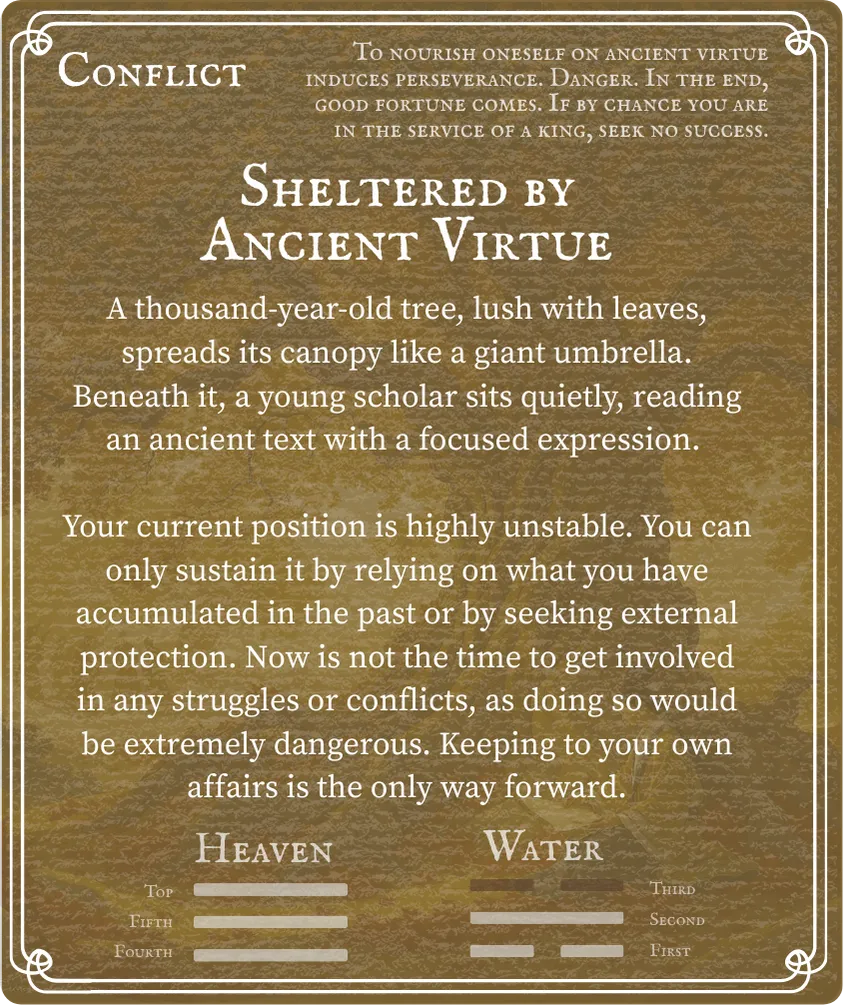
Six in the Third: To nourish oneself on ancient virtue brings perseverance in danger. In the end, good fortune. If by chance you are in the service of a king, seek not works.

Tuan Commentary

The Tuan Commentary says: Conflict — the upper trigram is strong, the lower dangerous. Danger meeting strength: Conflict. "You are sincere yet obstructed; a cautious halt brings good fortune" — because the strong line comes and gains the center. "Misfortune at the end" — conflict cannot be carried to completion. "It furthers one to see the great person" — this honors what is central and correct. "It does not further one to cross the great water" — one would fall into the abyss.

Hexagram 6 Conflict — Six in the Third Line Card

The Six in the Third is the third line of the Conflict hexagram — a yin line in the third position. "To nourish oneself on ancient virtue" means living off one's accumulated merits and past achievements rather than contending for new gains. "Perseverance in danger" acknowledges that the current situation is perilous. "In the end, good fortune" promises that steadfast adherence to what is right will ultimately bring a favorable result. "If in the service of a king, seek not works" counsels that if you participate in a larger enterprise, do the work quietly without claiming credit.

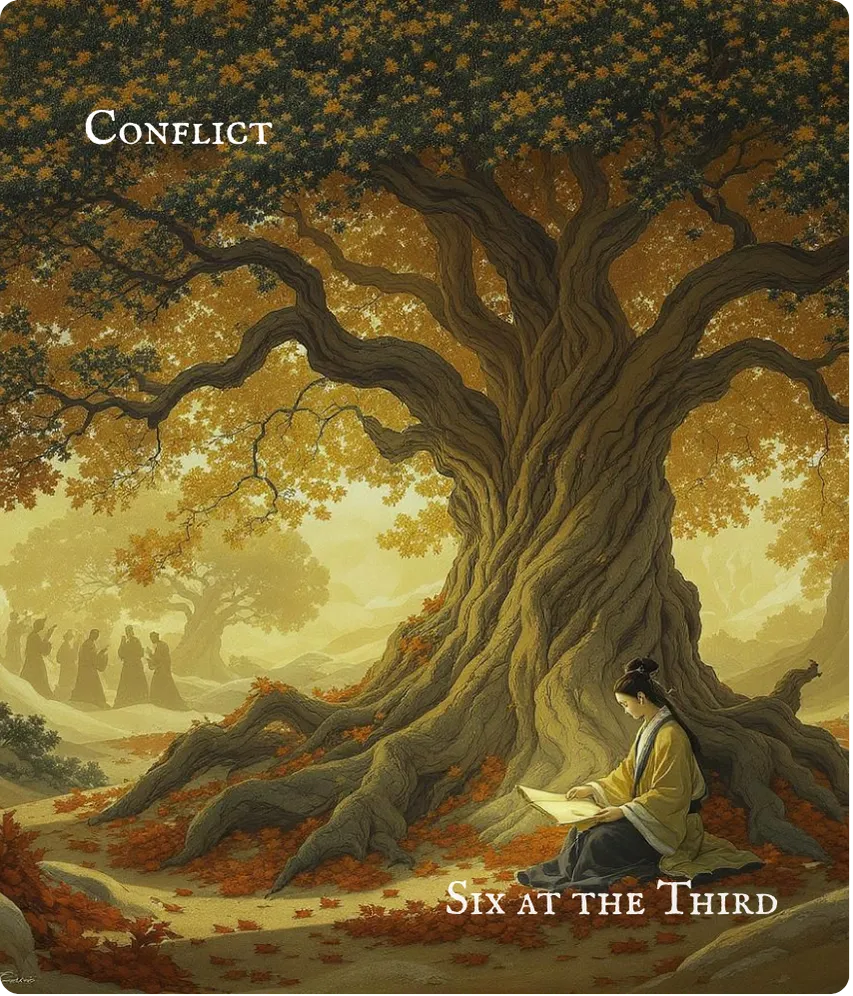
As the card depicts — a person rests peacefully beneath the shade of a great ancient tree. The tree represents accumulated virtue and past achievements that provide shelter even in turbulent times. You don't need to compete for new territory; what you already have is enough to sustain and protect you.

Yilore Reading

Sheltered by the Ancient Tree

Hexagram 6 Conflict — Six in the Third Card Front
Hexagram 6 Conflict — Six in the Third Card Back

Yilore interprets the Six in the Third of the Conflict hexagram as "Sheltered by the Ancient Tree." This card offers deep comfort in turbulent times: you already possess what you need to weather the storm.

The card depicts a person sitting peacefully beneath a massive, ancient tree. While winds may howl and conflicts rage around them, the tree's deep roots and broad canopy provide shelter. This tree represents your accumulated virtue, reputation, and past achievements — they form a protective shield even when the world around you is in turmoil.

The most liberating insight of this card is captured in "seek not works." In a culture that constantly pushes us to achieve more, compete harder, and claim credit loudly, this line says: stop. You don't need to prove anything right now. Your past speaks for itself. By staying humble, doing your work quietly, and not getting involved in the power struggles swirling around you, you not only survive but emerge stronger when the storm passes.


Divination Insights

The Six in the Third line in divination carries the core theme: "Rest on your existing merits, keep a low profile, and weather the storm quietly." You have accumulated enough goodwill and resources to see you through this difficult period. The overall tone: do not contend for more — protect what you already have.

Career

In career matters, the Six in the Third advises you to rely on your track record and accumulated reputation rather than competing for new positions or projects during this turbulent period. If your boss assigns you to a high-profile initiative, contribute diligently but do not seek the spotlight or claim credit. In times of conflict and political maneuvering, the safest strategy is to be the reliable workhorse, not the ambitious contender. Your past achievements are your shield.

Relationships

In matters of the heart, the Six in the Third suggests drawing on the deep reservoir of shared memories, mutual respect, and accumulated trust in your relationship. Don't try to "win" arguments or force your partner into new agreements. Instead, remind yourselves of why you came together in the first place. The strength of your bond lies in its history and the virtue you've built together over time.

Wealth

Financially, this line advises conservatism. Live on your existing savings and investments rather than chasing new, risky opportunities. If you have a stable income, be grateful for it and don't gamble it away seeking higher returns. In a time of conflict and uncertainty, the person who preserves their wealth is wiser than the one who tries to multiply it.

Health

Health-wise, the Six in the Third encourages you to draw on the healthy habits and routines you've built over time. Don't try drastic new diets or extreme fitness regimens during a stressful period. Stick with what has worked for you before. The ancient tree's shade represents the protective power of consistent, time-tested self-care practices.

Yilore app icon

Get the Yilore app

Full charts, daily hexagrams, and deeper AI readings on your phone.

App Store

FAQ

What does 'nourish oneself on ancient virtue' mean practically?

In practical terms, it means relying on what you've already built — your reputation, your savings, your relationships, your skills — rather than trying to acquire new things during a period of conflict. Don't chase promotions, don't start new ventures, don't make bold moves. Instead, rest on your existing merits and let them sustain you until the turbulence passes.

Why does the line say 'seek not works' when serving a king?

"Seek not works" means when participating in a larger enterprise or serving under authority, contribute your effort but do not claim credit or seek recognition. In times of conflict, those who stand out become targets. By staying humble and doing your work quietly, you avoid being drawn into power struggles. Your contribution will be recognized in due time — there is no need to advertise it.

Is the Six in the Third a good or bad line to receive?

It is ultimately positive — the line says "in the end, good fortune." However, it comes with a warning: "perseverance in danger" means the current situation is genuinely perilous. The good fortune is conditional on your willingness to stay humble, avoid contention, and rely on what you already have. If you can resist the temptation to grab for more, the outcome will be favorable.