
Hexagram 10 Treading (Conduct) Explained: Conduct, Propriety & Treading the Tiger's Tail | I Ching

I Ching Hexagram 10 Treading (Conduct) (Lü) explained. Symbolizing proper conduct and treading carefully — even on the tiger's tail without being bitten. Analysis of judgment, six lines, and guidance for navigating dangerous situations with grace.

Hexagram Overview

Hexagram Text

Treading upon the tail of the tiger. It does not bite the man. Success.

Image Commentary

Heaven above, the lake below: the image of Treading. Thus the superior person discriminates between high and low, and thereby strengthens the mind of the people.

Hexagram 10 Treading (Conduct) — Trigram Diagram

Treading (Lü) is the tenth hexagram of the I Ching. The upper trigram is Qian (Heaven) and the lower is Dui (Lake/Joy). The joyous, gentle lake treads upon the tail of the powerful, creative Heaven — a small, yielding force interacting with an overwhelming one. Remarkably, the tiger does not bite.

This hexagram is fundamentally about proper conduct in dangerous or unequal situations. When you face someone or something far more powerful than yourself, success depends not on strength but on propriety, grace, and proper behavior. The Image teaches the superior person to 'discriminate between high and low' — not out of servility, but from genuine understanding of how order and harmony are maintained. In modern terms, Treading speaks to navigating office politics, dealing with powerful people, handling delicate negotiations, and maintaining dignity while acknowledging reality.

Yilore Reading

Propriety — The Maiden Walking Beside the Tiger

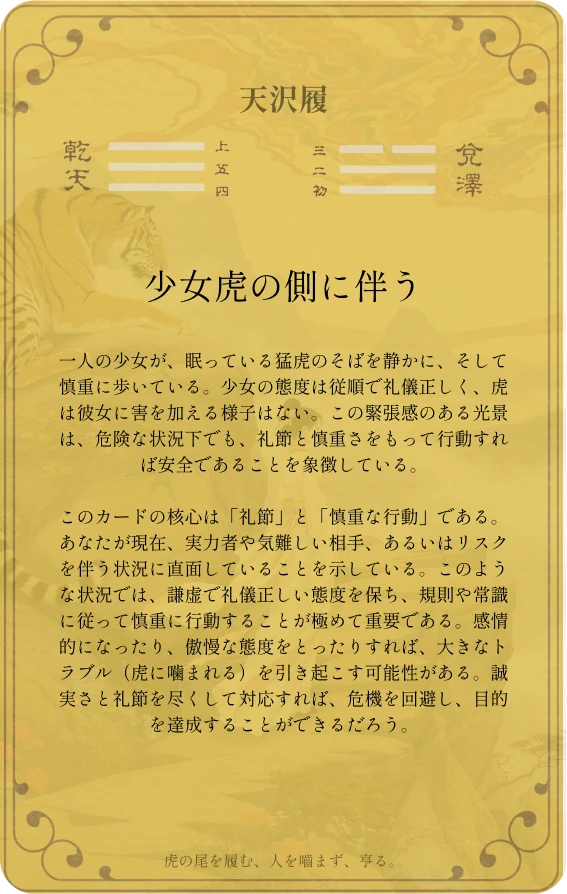
Hexagram 10 Treading (Conduct) Card — Front
Hexagram 10 Treading (Conduct) Card — Back

The Yilore "Treading (Conduct)" card captures one of the I Ching's most vivid images: a young woman walking calmly alongside a great tiger, her gentle hand resting near its tail.

Grace in the Face of Power

The card's central message is that genuine grace and proper conduct can navigate even the most dangerous situations safely. The maiden is not strong enough to fight the tiger, nor fast enough to flee it. But her gentle, proper demeanor — her natural grace — creates a space where the tiger's ferocity is calmed.

The Deeper Lesson of Conduct

This is not about weakness or submission. The maiden walks beside the tiger with dignity, not servility. She understands the reality of the power difference but does not let it diminish her. This card calls you to bring the same quality to your challenges: acknowledge the power of what you face, but maintain your own dignity and grace. When you do this, even tigers will not bite.

Divination Insights

Drawing Hexagram 10 — Treading signals a time to navigate carefully through a situation involving unequal power dynamics. Success depends not on strength but on proper conduct, grace, and genuine humility.

Career

Career

In career matters, Treading counsels careful navigation of power dynamics. You may be dealing with superiors, difficult clients, or institutional forces far more powerful than yourself. Success comes through proper conduct — respectful, sincere, and appropriate behavior. Don't challenge authority directly; instead, be the person whose genuine courtesy and competence disarms even the most formidable 'tiger.' This is not about being submissive but about being wise.

Love

Relationships

In love, Treading speaks to navigating power imbalances within a relationship, or approaching someone who seems 'out of your league.' The hexagram's message is encouraging: proper, sincere, and graceful conduct can win the heart of even the most formidable partner. Be yourself, be respectful, and let your genuine character speak. The tiger does not bite the one who treads with authentic grace.

Wealth

Wealth

Financially, Treading advises caution and propriety in dealings with larger financial forces — banks, markets, powerful business partners. Don't try to compete with overwhelming financial power; instead, navigate it with careful, proper conduct. Read the fine print, follow proper procedures, and maintain impeccable financial ethics. This is not the time for bold financial moves but for careful, well-mannered financial behavior.

Health

Health

Health-wise, Treading reminds you to treat your body with respect and proper conduct. Don't push beyond your limits or take reckless risks with your health. Like treading on the tiger's tail, be aware of the dangers of overexertion, poor habits, or ignoring warning signs. Careful, consistent self-care — proper conduct toward your own body — brings lasting health.

Line-by-Line Reading

Hexagram 10 — First Nine Card

First Nine

Simple Conduct — Going Forward Without Blame

Walking with simplicity and sincerity. When your conduct is genuine and unpretentious, you can move forward safely, even through challenging circumstances. The power of simplicity disarms even the most dangerous situations.

Hexagram 10 — Nine in the Second Card

Nine in the Second

Treading a Level, Easy Path — The Recluse's Good Fortune

Walking on smooth, open ground — the path of the quiet person who seeks nothing but keeps to the right way. In seclusion and simplicity, this person finds steady good fortune.

Hexagram 10 — Six in the Third Card

Six in the Third

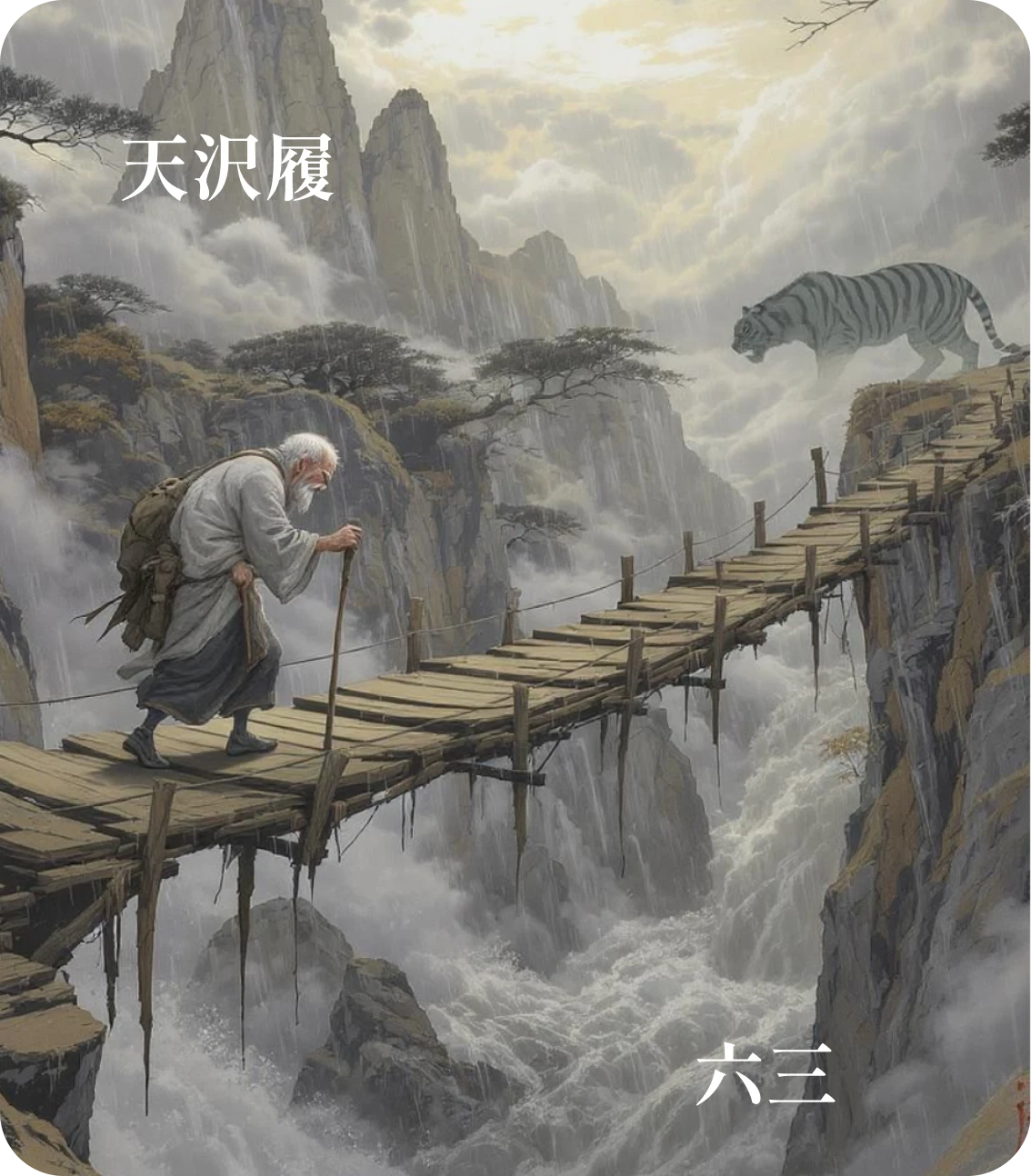
The One-Eyed Can See, The Lame Can Walk — Misfortune

Overestimating one's ability leads to disaster. A half-blind person thinks they can see; a lame person thinks they can walk on the tiger's tail. This arrogance in the face of danger brings certain misfortune.

Hexagram 10 — Nine in the Fourth Card

Nine in the Fourth

Treading on the Tiger's Tail With Caution — Good Fortune in the End

Approaching danger with full awareness and extreme caution. You know you are treading on the tiger's tail, and this very awareness keeps you safe. Fearful alertness leads to success.

Hexagram 10 — Nine in the Fifth Card

Nine in the Fifth

Resolute Conduct — Perseverance Brings Danger

Walking with determination and decisiveness, but this very resolve carries risk. The leader who acts too boldly or too independently may provoke the tiger. Even righteous determination needs tempering with caution.

Hexagram 10 — Nine at the Top Card

Nine at the Top

Looking Back on One's Conduct — Supreme Good Fortune

At the end of the path, looking back to examine your entire journey. When your conduct throughout has been proper and sincere, the review brings supreme good fortune — a life well-lived, a path well-walked.

易羅 アプリのアイコン

Get the Yilore app

Full charts, daily hexagrams, and deeper AI readings on your phone.

App Store

FAQ

What does 'treading on the tiger's tail' mean?

It is a vivid metaphor for navigating an extremely dangerous situation — interacting with someone or something far more powerful than yourself. The remarkable part is that 'the tiger does not bite,' meaning proper conduct can carry you safely through even the most perilous circumstances. The hexagram teaches that grace, propriety, and sincerity are more effective than strength in dealing with overwhelming power.

Is Hexagram 10 good or bad?

It is fundamentally positive — 'success' — but conditional. The good outcome depends entirely on your conduct. If you approach the dangerous situation with proper behavior, sincerity, and humility, you succeed. If you are arrogant or careless (like the Third line's 'one-eyed man'), disaster follows. The hexagram rewards propriety and punishes presumption.

How does this hexagram apply to dealing with difficult bosses?

It applies perfectly. The 'tiger' can represent any authority figure. The hexagram counsels: be respectful but not servile, competent but not threatening, sincere but not naive. Don't challenge your boss's authority directly (that's stepping on the tiger's tail carelessly). Instead, demonstrate your value through impeccable conduct and genuine results. Even the most difficult authority can be won over by authentic propriety.

What does 'discriminate between high and low' mean?

It means understanding the natural order of things — not in a servile way, but with clear-eyed realism. Some forces are stronger than you; some situations demand deference. Recognizing this reality is not weakness but wisdom. The superior person 'strengthens the mind of the people' by establishing clarity about how things work, allowing everyone to navigate safely.

What is the lesson of the Third line's 'one-eyed man'?

The Third line warns against overestimating your abilities when facing danger. The one-eyed man thinks he sees clearly but is actually half-blind; the lame man thinks he can walk but actually stumbles. This is the danger of self-delusion when facing powerful forces. Before you 'tread on the tiger's tail,' honestly assess whether you have the skill and awareness to do so safely. Arrogance in the face of danger is a death sentence.