Hexagram 26 The Taming Power of the Great — Six in the Fifth Line Explained

Six in the Fifth of Hexagram 26: The tusk of a gelded boar. Good fortune through dissolving conflict at its root with gentleness.

Yao Position Overview

Yao Text

Six in the Fifth: The tusk of a gelded boar. Good fortune.

Tuan Commentary

The Tuan Commentary says: The Taming Power of the Great. The strong and the solid, their radiance renews virtue daily.

Image Commentary

The Image says: Heaven within the mountain, The Taming Power of the Great. Thus the superior person acquaints himself with many sayings of antiquity and many deeds of the past, in order to strengthen his character thereby.

Hexagram 26 The Taming Power of the Great — Six in the Fifth Line Diagram

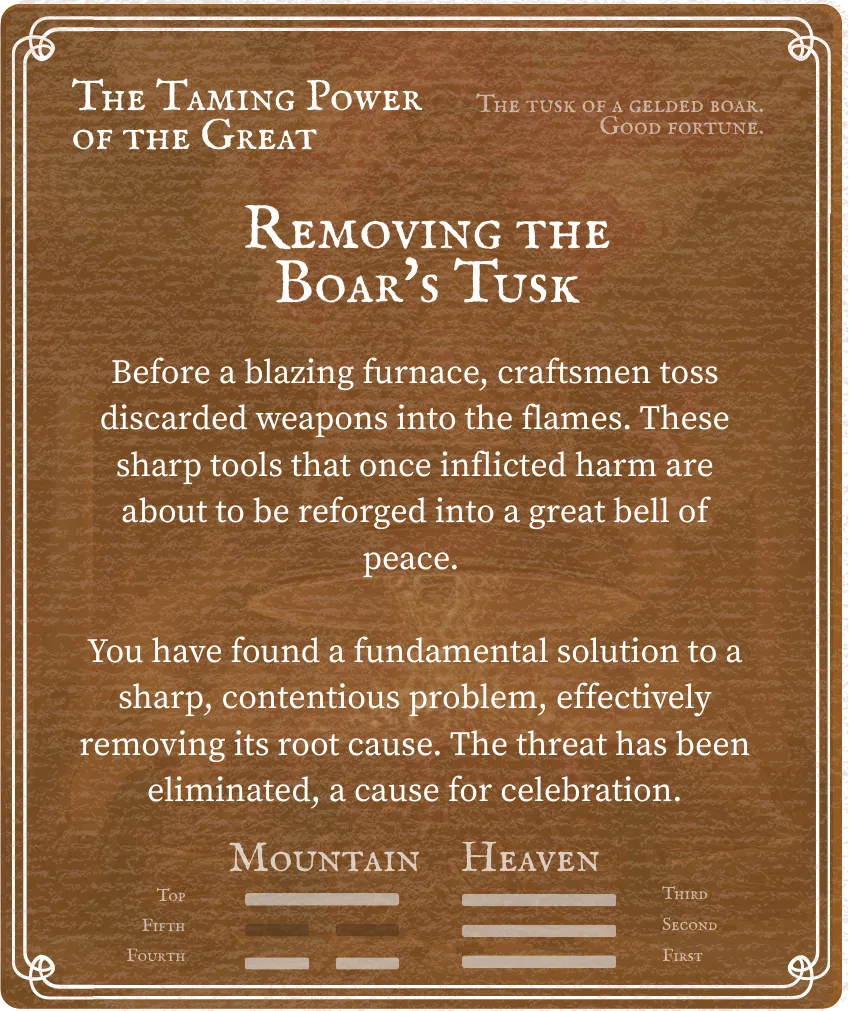
Six in the Fifth occupies the ruler's position, a yin line holding the center of the upper trigram, restraining Nine in the Second's yang energy below. "The tusk of a gelded boar. Good fortune" — by gelding the boar, its aggressive impulses are removed and it becomes docile and manageable. Good fortune.

The gelded boar still has sharp tusks, but it has lost the drive to attack because the root of aggression has been removed. This pairs with Six in the Fourth's "headboard of a young bull": the Fourth applies external restraint, while the Fifth dissolves the problem at its source — external control paired with internal transformation, two levels of management wisdom.

Six in the Fifth, gentle and centered, does not confront by force but dissolves the driving impulse at its root, transforming strong energy into useful power. The Xiao Xiang Commentary says: "There is cause for celebration" — thorough resolution through gentle means leaves no lingering trouble.

Modern Insight: Rather than clashing head-on with opposition, dissolve the root drive of aggression. In management, negotiation, and relationships, overcoming strength through gentleness and resolving issues at their source is far more effective and less costly than direct confrontation.


Yilore Reading

The Tusk of a Gelded Boar

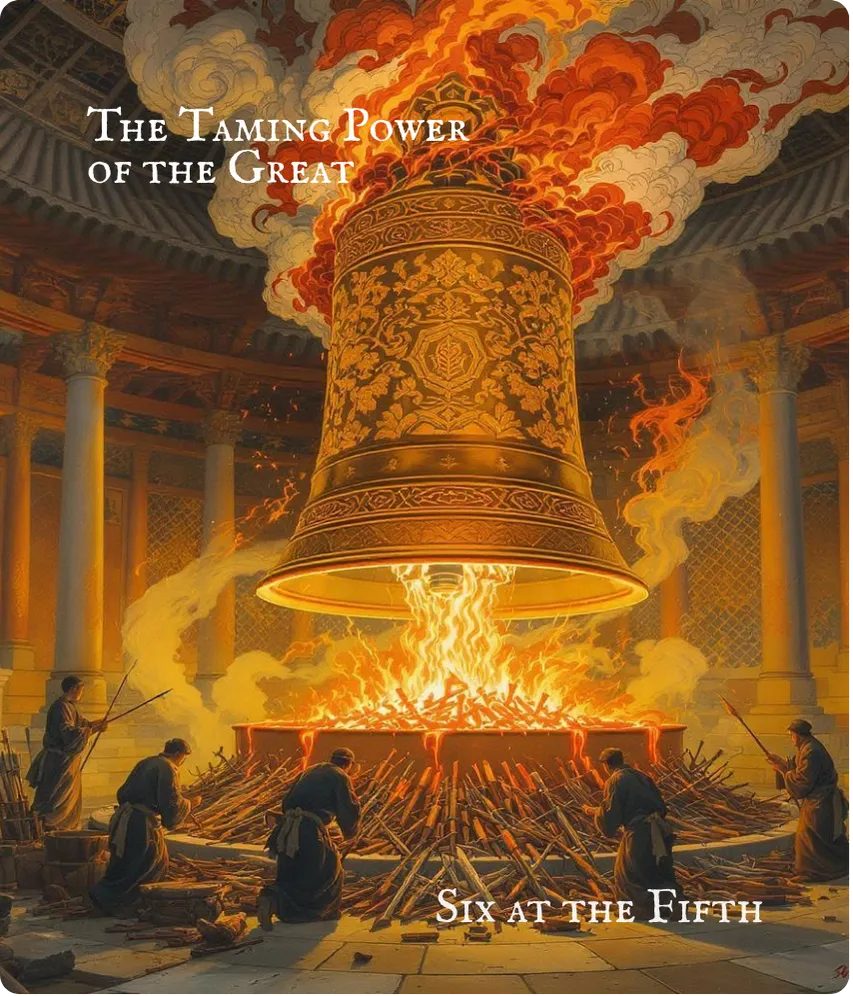
Hexagram 26 Six in the Fifth — Card Front
Hexagram 26 Six in the Fifth — Card Back

Yilore interprets Six in the Fifth as "the gentle master." When this card appears, it tells you that the most powerful resolution comes not from force but from understanding.

The gelded boar teaches a profound truth: you do not need to break the tusks to end the threat. You need only remove the impulse behind the aggression. The tusks remain — capability is preserved — but the destructive drive is gone. What was dangerous becomes useful.

In whatever conflict or challenge you face, look deeper. The surface manifestation of the problem is the sharp tusk. The real issue — the root drive — is something else entirely. Address that, and the tusks become harmless.

Divination Insights

Six in the Fifth speaks of mastering strength through gentleness — dissolving conflict at its root rather than confronting it directly.

Career

In career matters, Six in the Fifth advises resolving workplace conflicts at their root. Rather than engaging in power struggles, understand what drives the opposition and address those underlying concerns. If managing a team, create conditions that naturally align people's motivations with organizational goals — this is far more effective than enforcing compliance.

Relationships

In love, Six in the Fifth suggests resolving tensions at their emotional root rather than arguing over surface issues. Understand what your partner truly needs or fears, and address that directly with compassion. When the root of conflict is gently resolved, harmony returns naturally and completely.

Wealth

Financially, this line advises addressing the root causes of financial stress rather than treating symptoms. If overspending is driven by emotional needs, address those needs. If investment anxiety stems from lack of knowledge, educate yourself. Solving financial problems at their source creates lasting stability.

Health

For health, Six in the Fifth points to treating root causes rather than symptoms. If chronic stress manifests as physical ailments, address the stress itself. If unhealthy habits stem from emotional patterns, work on those patterns. True healing comes from addressing the source, not suppressing the symptoms.

이라 앱 아이콘

Get the Yilore app

Full charts, daily hexagrams, and deeper AI readings on your phone.

App Store

FAQ

What does 'the tusk of a gelded boar' symbolize?

A gelded boar retains its sharp tusks but has lost the aggressive drive to use them. It symbolizes neutralizing a threat not by removing its capability, but by removing its motivation. This is a more sophisticated approach than the "headboard of a young bull" — instead of external control, it achieves internal transformation.

How does Six in the Fifth differ from Six in the Fourth?

Both manage strong energy through gentleness, but at different levels. Six in the Fourth (the headboard) applies external restraint early. Six in the Fifth (gelding) removes the internal source of aggression. The Fourth prevents problems through early intervention; the Fifth resolves them at their deepest root. Together they represent complete management wisdom.

What is the practical application of this line?

In any situation where you face strong opposition or conflict, look for the underlying motivation driving the opposition rather than trying to overpower it directly. If you can address the root cause — whether it's a legitimate concern, a fear, or an unmet need — the opposition naturally dissolves, just as a gelded boar becomes docile despite its sharp tusks.