Hexagram 32 Duration — Six in the Fifth Line Explained

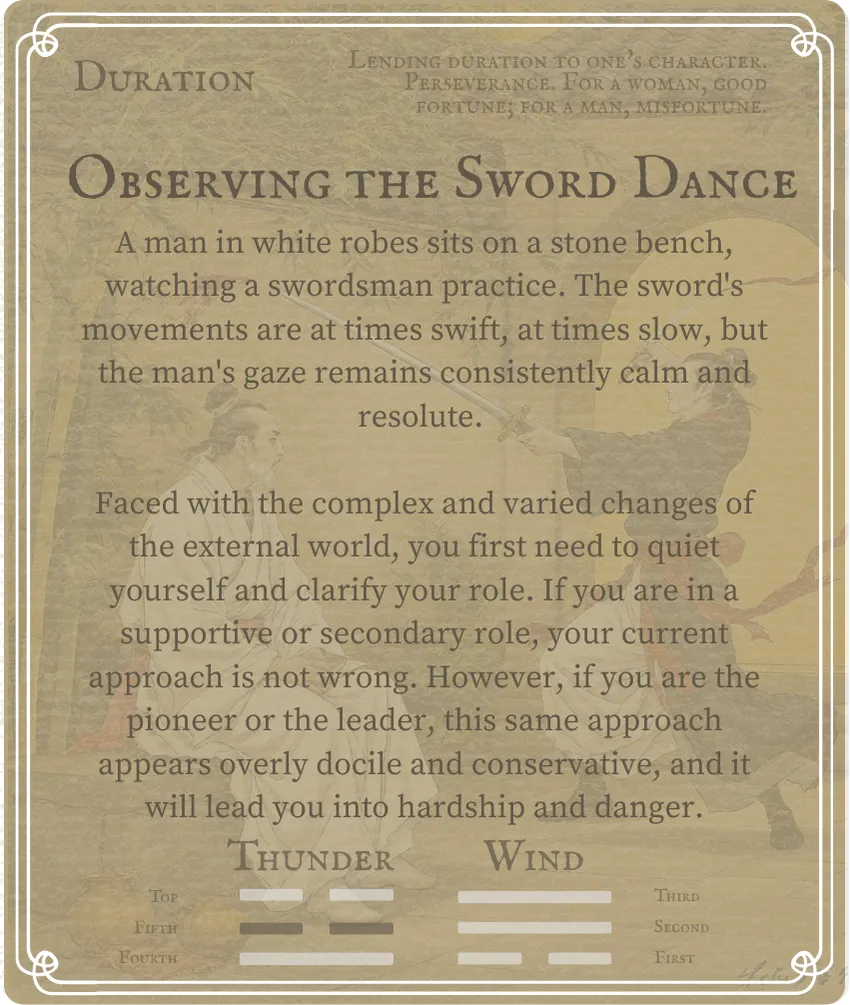
Six in the Fifth: Giving duration to character. Good fortune for a wife, misfortune for a husband. Know your role — supporters thrive with gentleness, leaders need decisiveness.

Yao Position Overview

Yao Text

Six in the Fifth: Giving duration to one's character. Perseverance. Good fortune for a wife. Misfortune for a husband.

Tuan Commentary

The Tuan Commentary says: Duration means 'lasting.' The firm above and the yielding below; thunder and wind work together; the yielding and the active both respond — this is Duration. Duration brings success, no blame, and perseverance furthers because it endures in its proper way.

Hexagram 32 Duration — Six in the Fifth Line Diagram

Six in the Fifth is the fifth line of Duration, a yin line in a yang position (out of place), at the honored position but holding the center. 'Giving duration to character' means consistently maintaining virtue — forming a direct positive contrast with Nine in the Third's 'not giving duration to character.' 'Good fortune for a wife' means it is auspicious for women (those in supporting roles). 'Misfortune for a husband' means it is dangerous for men (those in leading roles).

This is the most subtle line in Duration — the same behavior (giving duration to character) produces completely opposite results for different roles. Six in the Fifth, a yin line in the honored position, endures through gentle constancy. For 'the wife' (supporter, cooperator, follower), this gentle endurance is a perfect virtue. But for 'the husband' (leader, pioneer, decision-maker), gentle endurance alone is insufficient — more initiative and assertiveness are required.

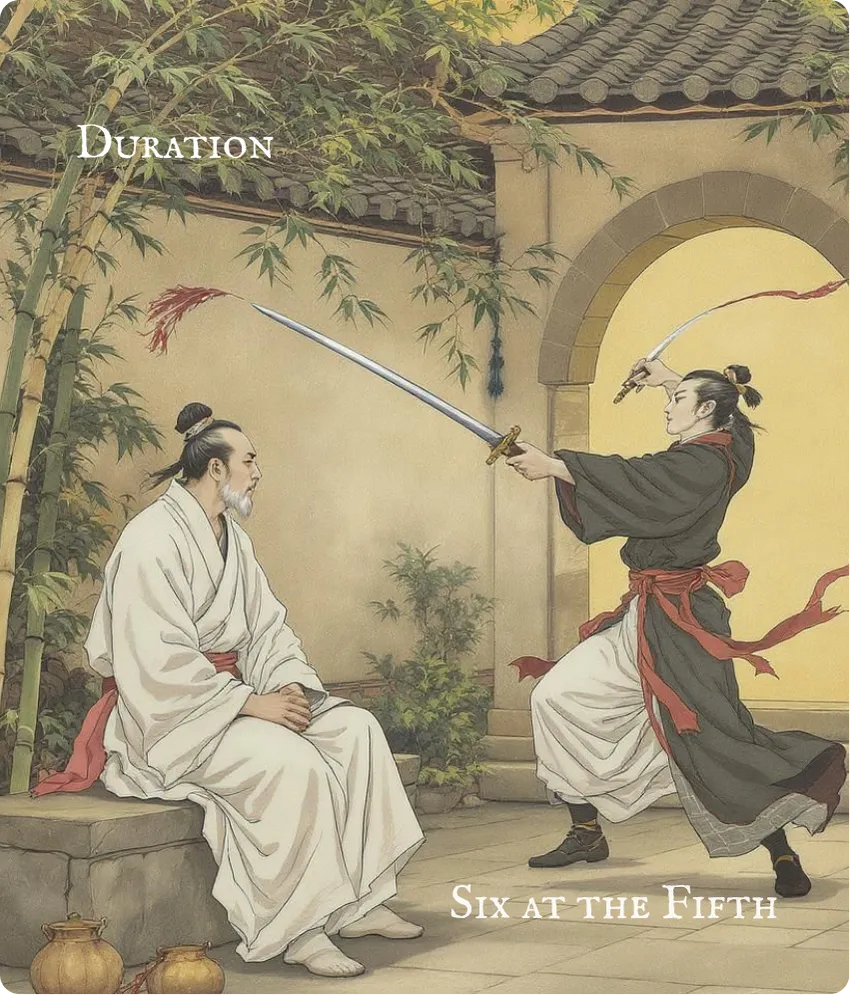
As the card depicts — a man in white sits on a stone bench watching a swordsman perform. The sword flashes swift then slow, while the man's gaze remains steady and composed. Facing the turbulent changes of the outside world, you need first to be still and see clearly your role: if you're a supporter, your current approach is fine; but if you're a leader, your current approach is too gentle and conservative, which will bring you into difficulty.

Yilore Reading

Watching the Swordplay

Hexagram 32 Duration Six in the Fifth Line — Front
Hexagram 32 Duration Six in the Fifth Line — Back

Yilore interprets Six in the Fifth of Duration as 'role determines strategy.' The white-robed man sitting on the stone bench watching the swordplay — his gaze is steady, his manner composed. If he is an advisor or strategist, this calm observation is ideal: analyzing coolly, not rushing to intervene, offering precise counsel at the critical moment. But if he is the general who should be wielding the sword — just sitting and watching is dereliction.

'Good fortune for a wife, misfortune for a husband' is the I Ching's most direct 'role analysis' — it's not saying women are better than men or men worse than women. It's saying: the same behavioral pattern produces different results in different roles.

Six in the Fifth, with its yin gentleness at the honored position, practices 'gentle endurance' — holding steady, cooperating, maintaining, supporting. This quality is golden in a supporter's position. But if you're expected to be a leader, decision-maker, or pioneer — gentle endurance alone isn't enough. Leaders must step up at the critical moment, make decisions, and bear risk.

The key isn't whether 'gentle' or 'firm' is better — but what your current role requires. First determine whether you're the 'observer' or the 'swordsman' — then apply the right strategy.


Divination Insights

The core theme is 'identify your role, match your strategy.' Your current approach of gentle, steadfast perseverance is perfectly correct if you're in a supporting role; but needs more proactive assertiveness if you're in a leading role. Ask yourself first: in the current situation, should I be the one sitting and watching, or the one stepping up to act?

Career

Six in the Fifth requires you to clarify your role at work. If you're a team supporter, coordinator, or advisor — continue your flexible, enduring strategy; you're doing great (good fortune for a wife). But if you're a project lead, department head, or entrepreneur — just being a cooperator isn't enough (misfortune for a husband). Leaders need to step up when it's time, make the call when it's needed. Don't use 'gentleness' as an excuse to avoid making decisions.

Relationships

In modern context, 'good fortune for a wife, misfortune for a husband' means: if you naturally play the accepting, responding role in love — maintaining warmth and stability is fine. But if you're the one who needs to actively advance the relationship — just waiting won't work. Sometimes love needs you to take initiative — arrange a date, say what's in your heart, plan something romantic. Passively 'giving duration to character' won't bring you the happiness you seek.

Wealth

Financially, Six in the Fifth reminds you to distinguish between 'preserving wealth' and 'growing wealth.' If your goal is to keep existing assets from losing value — the gentle, conservative strategy (term deposits, low-risk funds) is perfectly suitable. But if you need growth — just holding isn't enough. You need to more actively seek opportunities and accept moderate risk. 'Good fortune for a wife' in investing is capital preservation; 'misfortune for a husband' is expecting high returns from a preservation strategy.

Health

For health, Six in the Fifth's contemplative approach suits wellness and maintenance — meditation, tai chi, yoga, walking — these gentle activities are excellent for this line. But if your health goals require more active intervention (weight loss, muscle building, rehabilitation), gentle exercise alone isn't enough. Match your method to your goal — wellness and training are two different things.

이라 앱 아이콘

Get the Yilore app

Full charts, daily hexagrams, and deeper AI readings on your phone.

App Store

FAQ

What does 'good fortune for a wife, misfortune for a husband' mean?

'Good fortune for a wife' — for those in supporting, assisting, following roles, the gentle constancy of Six in the Fifth is auspicious. 'Wife' here doesn't specifically mean women — it refers to anyone currently playing a supporting role. 'Misfortune for a husband' — for those in leading, pioneering, decisive roles, this same gentle constancy is dangerous. 'Husband' doesn't specifically mean men — it refers to anyone who needs to take active charge. The core logic: the same behavior produces completely different results in different roles. Compliance and cooperation are virtues in an assistant, but dereliction in a leader.

How do I determine whether I'm in the 'wife' or 'husband' role?

Criteria: If people expect you to make decisions — you're the 'husband.' If others are waiting for your opinion and direction — you're the 'husband.' If you'd be held responsible if things went wrong — you're the 'husband.' If none of the above — you're the 'wife' (supporter). Note: roles aren't fixed — you might be the 'husband' at work (department head) and the 'wife' at home (deferring to your partner's decisions). Match the right strategy to each context.

What should I do if I receive the Six in the Fifth changing line?

Core advice: 'identify your role, adjust your strategy.' First, honestly assess — what role are you in the current situation? Is anyone waiting for you to decide? Second, if you're the supporter — congratulations, carry on. Your gentleness and stability are your greatest value. Third, if you're the leader — you may need to be more assertive. Don't always wait for others to act first. Make decisions — even imperfect ones — rather than endless 'observation.' Fourth, don't let the role trap you — Six in the Fifth's gentle quality isn't your destiny. If circumstances demand you shift from supporter to leader, you can do it.