Hexagram 32 Duration — Six at the Top Line Explained

Six at the Top: Restlessness in duration brings misfortune. A warning against purposeless agitation when stability reaches its breaking point — like a volcanic eruption.

Yao Position Overview

Yao Text

Six at the Top: Restlessness in duration brings misfortune.

Tuan Commentary

The Tuan Commentary says: Duration means 'lasting.' The firm above and the yielding below; thunder and wind work together; the yielding and the active both respond — this is Duration. Duration brings success, no blame, and perseverance furthers because it endures in its proper way.

Hexagram 32 Duration — Six at the Top Line Diagram

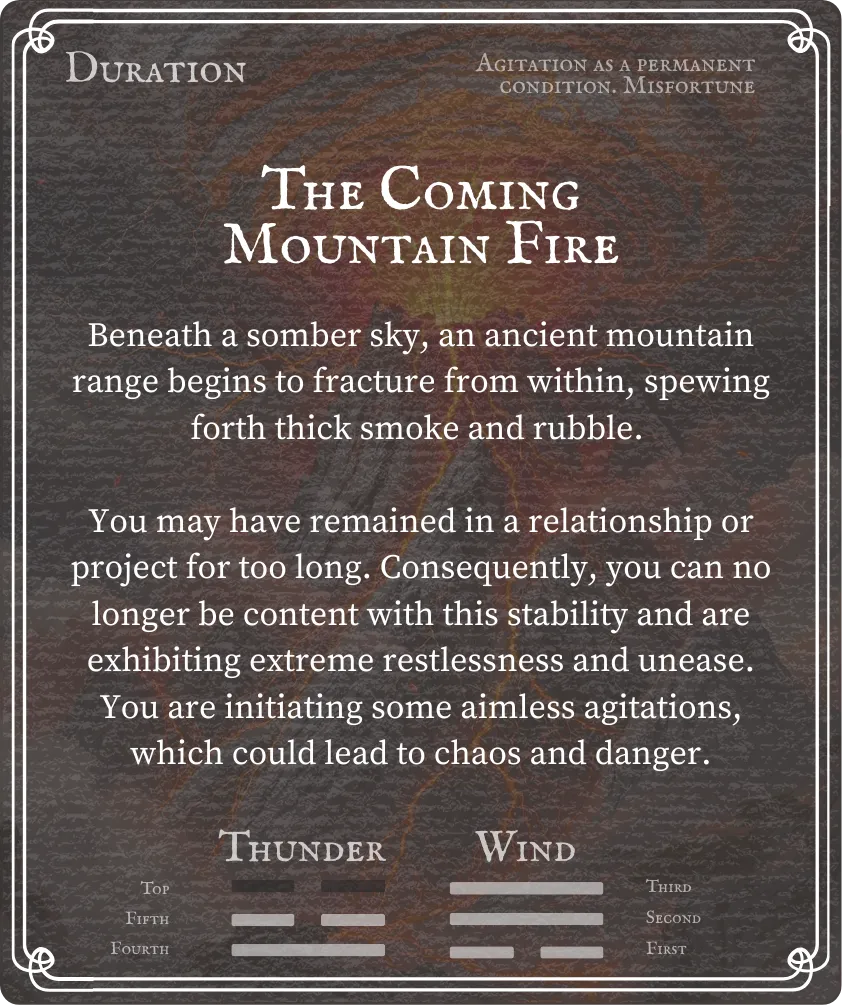
Six at the Top is the final line of Duration, a yin line in a yin position (properly placed), at the very extreme of the hexagram. 'Restlessness in duration' means sudden shaking within the enduring state. 'Misfortune' is the clear verdict.

The Six at the Top sits at Duration's terminus — having 'endured' far too long. Things at their extreme reverse — anything maintained to its absolute limit flips to its opposite. The Six at the Top doesn't lack desire for endurance — it has endured to the very end and suddenly can't tolerate the unending sameness. So it becomes agitated — but this agitation lacks direction, lacks purpose — it's merely the emotional outburst of 'I can't stand this anymore.'

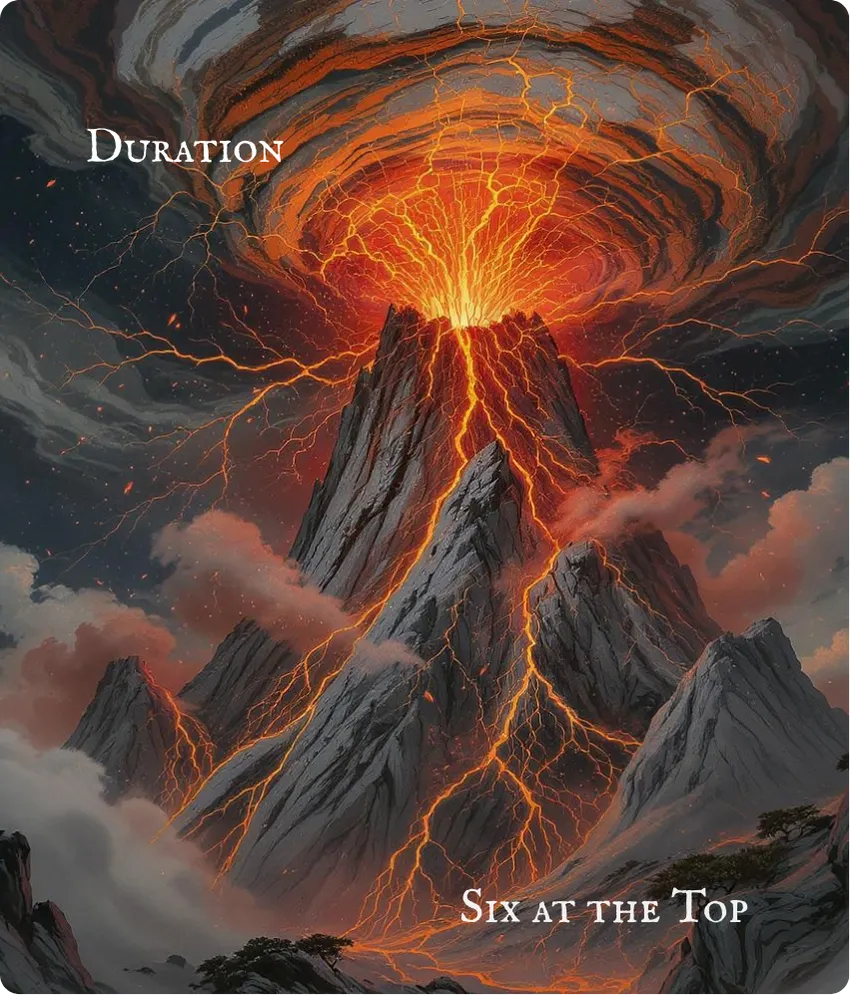
This is like a volcano silent for a thousand years — magma has accumulated beneath the surface for too long, until one day the pressure exceeds the breaking point and it erupts from within. The force is staggering — but it is destructive, not constructive.

As the card depicts — beneath an ominous sky, an ancient mountain range fractures from within, smoke and debris surging forth. You may have stayed too long in a relationship or project, unable to bear the stability, expressing extreme agitation and restlessness, beginning aimless upheaval that may bring chaos and misfortune.

Yilore Reading

The Volcano Within

Hexagram 32 Duration Six at the Top Line — Front
Hexagram 32 Duration Six at the Top Line — Back

Yilore interprets the Six at the Top of Duration as 'self-destruction within stability.' That crumbling mountain — it was once so majestic, so steady. Millennia of wind and rain never shook it. But what ultimately destroyed it wasn't external force — it was the eruption of its own internal pressure.

'Restlessness in duration' contains a profound paradox — 'duration' means stability, endurance, constancy; 'restlessness' means shaking, upheaval, sudden change. When someone has 'endured' to the absolute extreme, they develop revulsion and dread toward stability itself. They begin to think 'what's the point of a life that never changes?' Then they start to thrash — but this thrashing isn't thoughtful change; it's an emotional explosion.

This phenomenon is all too common in reality: suddenly having an affair in a stable marriage — not from falling out of love, but from not being able to bear the daily sameness. Suddenly quitting a stable job — not because something better awaits, but from not being able to bear the daily repetition. Suddenly going all-in on a gamble from a stable investment strategy — not because a better opportunity appeared, but from not being able to stand the slow pace of steady returns.

'Misfortune' — such purposeless agitation is almost certain to be disastrous, because you've destroyed the stability you had without anything better to replace it. After the volcano erupts, only scorched earth remains.

Duration's complete arc from First Six to Six at the Top: Starting too fast (First Six seeking depth) → Finding rhythm (Nine in the Second, remorse disappears) → Unable to persist (Nine in the Third, inconstancy) → Wrong direction (Nine in the Fourth, no game) → Role matching (Six in the Fifth, wife vs. husband) → Self-destruction at the extreme (Six at the Top, restlessness). The top line's lesson: the way of endurance needs 'living water' — while keeping the core unchanged, introduce fresh elements and changes at the right time. Not that change is forbidden — but it must be done wisely, not by waiting for the volcano to erupt.

Divination Insights

The core theme is 'beware of self-destructive impulse within stability.' You may have accumulated enormous discontent and restlessness within a long-maintained stable state. Without proper channeling, it may erupt in an extreme fashion. Find healthy ways to introduce change — don't wait for the volcano to blow.

Career

The top line warns against impulsively quitting or making drastic career changes simply because you're bored with your stable job. 'Restlessness in duration brings misfortune' — directionless change is more dangerous than no change at all. If you genuinely feel your current work no longer fulfills you, create a planned transition rather than flipping the table in a moment of frustration. You can explore new possibilities while keeping your current position — gradual change is far safer than sudden upheaval.

Relationships

In love, Six at the Top is a stark warning against the 'seven-year itch' crisis in long-term relationships. Stable relationships can breed 'this is all there is' ennui — then one day an inappropriate person appears or an inappropriate thought arises and you start doing reckless things. 'Misfortune' — such impulses will destroy the relationship you built with years of devotion. If you feel the relationship needs fresh air — seek it together with your partner (travel, new hobbies, deep conversations), not behind their back.

Wealth

Financially, the top line warns against abandoning a long-term steady-income strategy for an impulsive all-in gamble out of boredom. 'Restlessness in duration brings misfortune' — the person who steadily earns 8% annually ends up far wealthier than those who bet everything, double up, then go to zero. If you find investing boring — that means you're doing it right. Boring investments are often the most profitable.

Health

For health, the top line warns against suddenly indulging after maintaining a healthy lifestyle for a long time — 'my body is so strong, one binge can't hurt.' Years of accumulated health capital can be severely depleted by one extreme indulgence. Also watch your mental health — a state that's outwardly calm but internally high-pressure may suddenly collapse one day. Find outlets for stress release — exercise, talking, vacations — don't let the internal 'magma' build to an uncontrollable level.

이라 앱 아이콘

Get the Yilore app

Full charts, daily hexagrams, and deeper AI readings on your phone.

App Store

FAQ

What does 'restlessness in duration' mean in the top line?

'Restlessness in duration' means sudden shaking within a state of long stability. 'Restlessness' means to shake, to agitate violently. 'Duration' means long-term stability. Together they describe an eruption after endurance has reached its extreme — like a rubber band stretched too long suddenly snapping. The Six at the Top sits at Duration's terminus — having 'endured' too long. Things at their extreme reverse — any state taken to its limit turns into its opposite. The Six at the Top doesn't lack desire for endurance — it has endured to the breaking point and suddenly can't bear the unchanging state any longer. So it becomes agitated — but this agitation has no direction, no purpose — only the outburst of 'I can't go on like this anymore.'

Can too much stability really cause problems?

Yes — the top line of Duration reveals a counterintuitive but deeply true principle: excessive stability is itself the seed of instability. Three reasons: First, the human psyche needs moderate change and stimulation — a life completely without change generates enormous suppressed discontent. Second, the external environment keeps changing — you don't change but the world does, and the tension between them keeps growing. Third, suppressed energy doesn't disappear — it just accumulates. Once it reaches a tipping point, eruption becomes inevitable. This doesn't mean stability is bad — but that healthy stability must include moderate change, like a river — it flows continuously (enduring), but every moment the water is new (changing). Stagnant water breeds decay.

What should I do if I receive the Six at the Top changing line?

Core advice: 'release in an orderly way, seek change wisely.' First, acknowledge your discontent — don't pretend everything is fine. If you feel suffocated by current stability, that feeling is real and needs to be honored. Second, don't act impulsively — 'restlessness in duration brings misfortune' tells you: purposeless eruption only brings disaster. Don't make any major decisions at the peak of emotions. Third, find healthy outlets — deep talks with friends, travel somewhere new, learn a new skill. Introduce freshness without destroying the foundation. Fourth, plan change deliberately — if change is truly needed, turn it into a phased plan with contingencies rather than an impulsive rupture.