


Hexagram 7 The Army — Six at the Top Line Explained

Six at the Top: The great prince issues commands, founds states, establishes clans. Inferior people should not be employed. Post-victory governance and the wisdom of rewarding merit appropriately.

Yao Position Overview

Yao Text

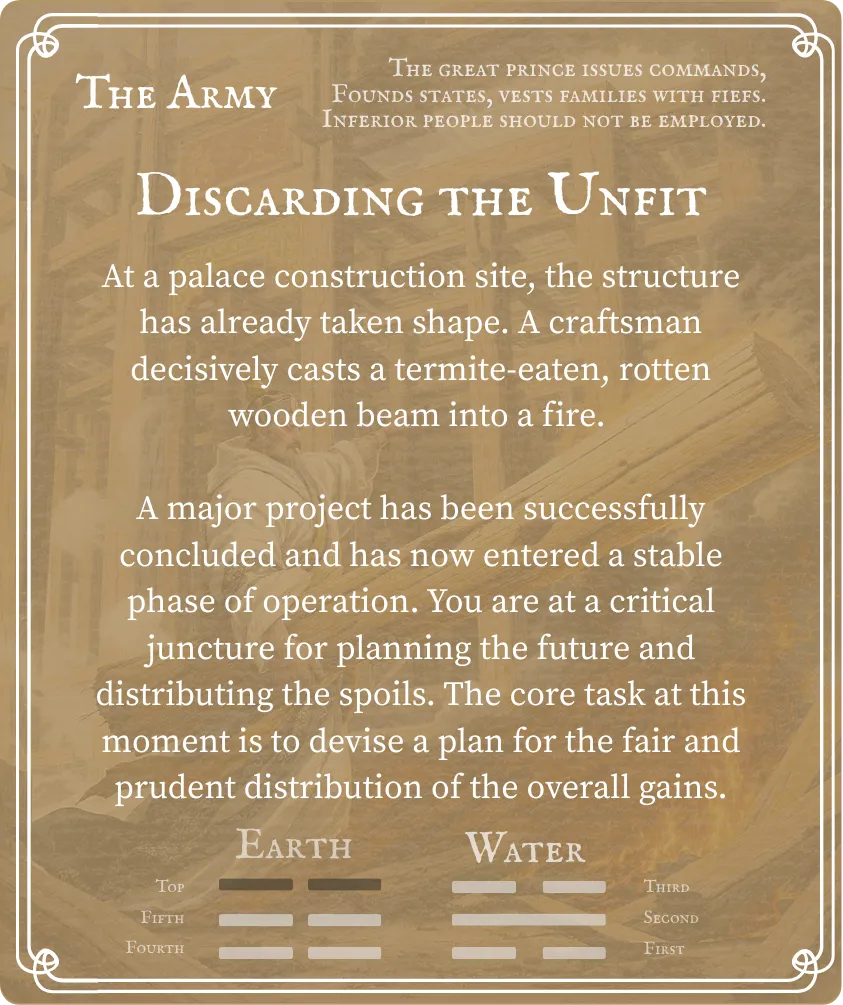
Six at the Top: The great prince issues commands, founds states, establishes clans. Inferior people should not be employed.

Tuan Commentary

The Tuan Commentary says: The Army means the masses. Perseverance means correctness. He who can lead the masses with correctness may be king. The strong line gains the center and is responded to; going forth in the midst of danger and acting obediently — with this one may poison all under heaven, and the people follow. Good fortune — what blame could there be?

Hexagram 7 The Army — Six at the Top Line Card

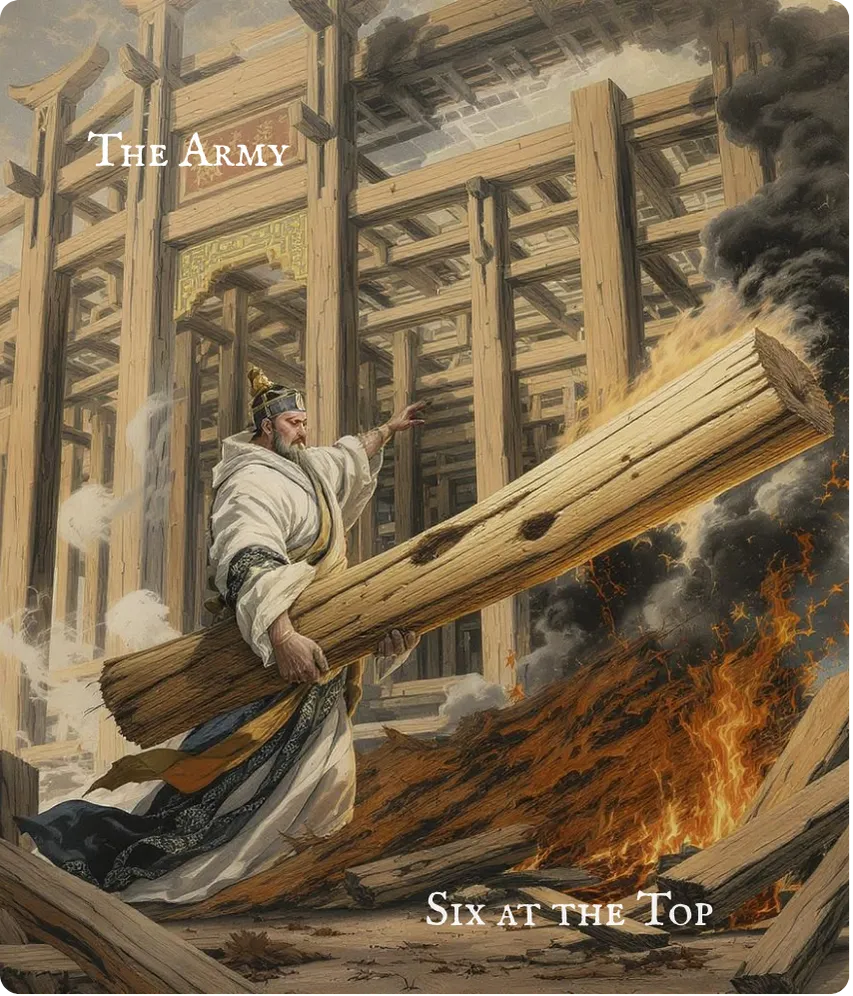
The Six at the Top is the final line of The Army hexagram — a yin line at the highest position, representing the aftermath of military victory. 'The great prince issues commands, founds states, establishes clans' describes the rewarding of meritorious officers with lands and titles. But 'inferior people should not be employed' adds a crucial caveat: those of low character should receive material rewards, not positions of power.

As the card depicts — a ruler distributes fiefdoms after victory, carefully distinguishing between those worthy of governance and those who should receive only material compensation. True statesmanship lies not just in winning the war but in wisely managing the peace that follows.

Yilore Reading

The Spoils of Victory

Hexagram 7 The Army — Six at the Top Card Front
Hexagram 7 The Army — Six at the Top Card Back

Yilore interprets the Six at the Top of The Army as 'The Spoils of Victory.' This card addresses perhaps the most difficult challenge in any campaign: managing success wisely.

The card shows a ruler in the moment of triumph, distributing rewards and establishing a new order. But the card's warning — 'inferior people should not be employed' — casts a shadow over the celebration. History is full of examples where brilliant military victories were followed by disastrous governance because the wrong people were given power.

The card's essential wisdom is that winning is only half the battle. The harder part is building something lasting from your victory. This requires the discernment to distinguish between those who deserve authority and those who deserve only material reward — and the courage to make that distinction even when it is unpopular.

Divination Insights

The Six at the Top in divination addresses the critical question of what happens after success: how do you reward the meritorious and organize the new order? Success in battle means nothing if the peace is mismanaged.

Career

After achieving a professional victory — completing a major project, winning a contract, or successfully restructuring — the Six at the Top calls for wise distribution of rewards and responsibilities. Promote those who demonstrated both competence and character. Reward the hard-working but less capable with bonuses or recognition, but do not give them managerial authority. The wrong person in a leadership role after victory can undo everything you fought to achieve.


Relationships

In relationships, after successfully navigating a crisis together, this line advises establishing new patterns and boundaries. Reward the relationship with renewed commitment, shared experiences, and deeper trust. But be careful about allowing toxic habits or people back into your life just because the crisis has passed.

Wealth

Financially, after a significant gain — a successful investment, a business victory, or an inheritance — the Six at the Top warns against entrusting your wealth to unscrupulous advisors. Reward yourself and your partners fairly, but be extremely careful about who gains control over financial resources going forward.

Health

After recovering from a health crisis, the Six at the Top advises establishing healthy new routines and maintaining the discipline that brought you through. Don't reward yourself with indulgence that undermines your recovery. And be cautious about health advice from unqualified people — stick with proven practitioners.

易羅 アプリのアイコン

Get the Yilore app

Full charts, daily hexagrams, and deeper AI readings on your phone.

App Store

FAQ

What does 'inferior people should not be employed' mean?

It means that people who lack moral character — regardless of their ability or their contribution to the victory — should not be given positions of authority. They can be rewarded materially (bonuses, gifts, recognition) but should never be placed in charge of others. The reasoning is clear: a person of low character in a position of power will corrupt the very system they helped build.

How do I wisely manage success after a victory?

Three principles: (1) Reward merit fairly — those who contributed most deserve the greatest recognition; (2) Distinguish between competence and character — give authority only to those with both; (3) Establish clear new structures — don't let the euphoria of victory lead to complacency. The most dangerous period in any campaign is often just after the victory, when discipline relaxes and infighting over spoils begins.

Why is post-victory governance so important?

Because the purpose of any 'army' — any organized collective action — is to create a better situation, not just to win a battle. If the peace that follows is mismanaged, the victory was meaningless. In business terms, winning a contract means nothing if you can't deliver. In personal terms, overcoming a crisis means nothing if you return to the same habits that caused it. The Six at the Top reminds us to think beyond the battle to the world we want to build after it.