


Hexagram 3 — Difficulty at the Beginning: Six in the Second Line Explained

Six in the Second: Difficulties pile up. Horses and wagon part. Not a robber but a wooer. The maiden does not pledge herself. Ten years — then she pledges. This line symbolizes agonizing indecision, yet perseverance will ultimately bring a turning point.

Yao Position Overview

Yao Text

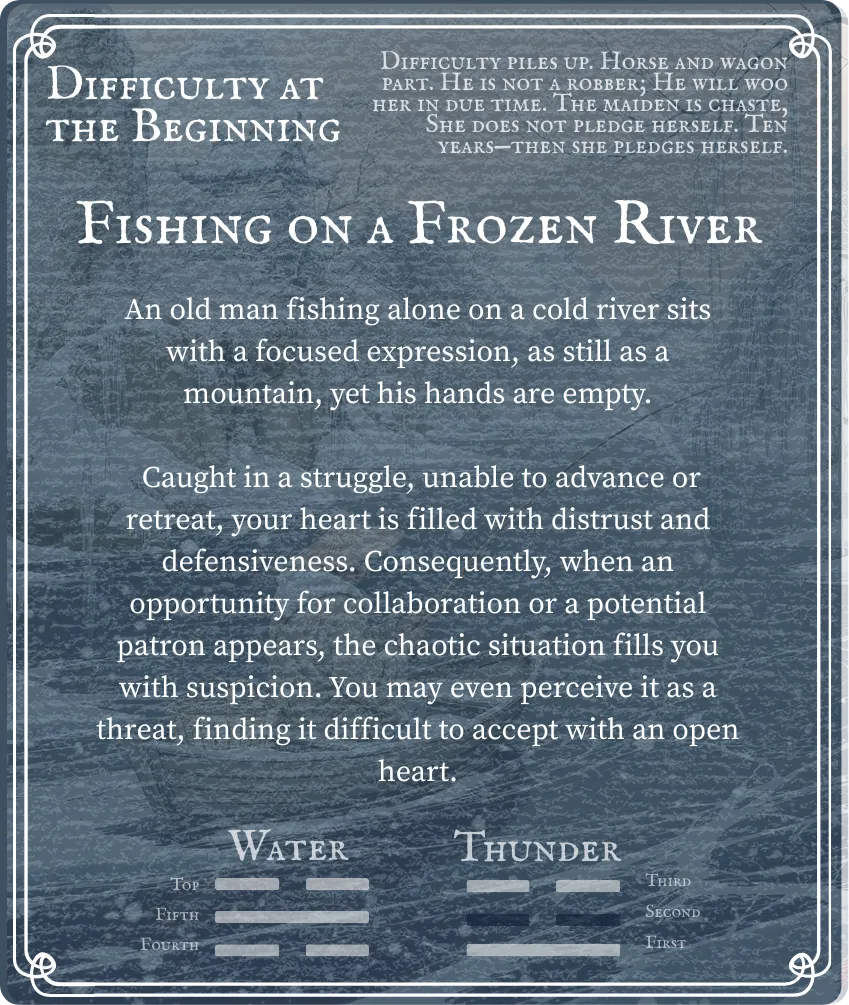
Six in the Second: Difficulties pile up. Horses and wagon part. He is not a robber; he wants to woo. The maiden is chaste; she does not pledge herself. Ten years — then she pledges herself.

Tuan Commentary

The Tuan Commentary says: Difficulty at the Beginning — the firm and the yielding begin to interact, and difficulty is born. Movement amid danger leads to sublime success through perseverance. The movement of thunder and rain fills all things to overflowing. Heaven creates the primal chaos — it is fitting to appoint helpers, yet there shall be no rest.

Hexagram 3 Difficulty at the Beginning — Six in the Second Line Card

The Six in the Second is the second line of Hexagram 3 — a yin line in the central position. "Difficulties pile up" describes being stuck and unable to advance. "Horses and wagon part" depicts riding a horse yet being unable to move forward — having the means and ability to progress, yet being held back by countless concerns. "Not a robber but a wooer" reveals that the approaching figure is not an enemy but a potential ally. Yet due to the confusion of the times, one cannot discern the other's true intentions and must remain cautious.

The phrase "the maiden does not pledge herself; ten years — then she pledges" teaches that holding to one's principles may make the wait long and painful, but the right outcome will eventually come. This line captures the torment of being caught between advance and retreat — opportunities appear but trust is lacking. The key lesson is to maintain composure without closing yourself off, to be cautious without becoming paranoid.

Yilore Reading

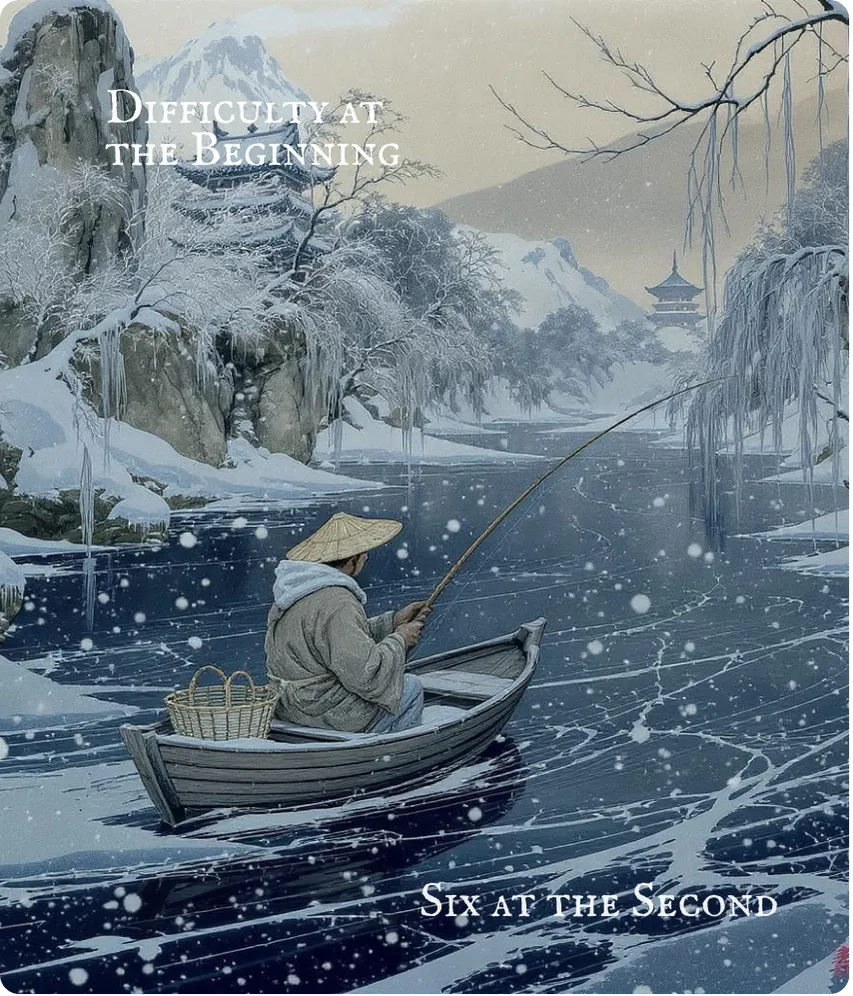
Fishing Alone in the Cold River

Hexagram 3 Difficulty at the Beginning — Six in the Second Line Front
Hexagram 3 Difficulty at the Beginning — Six in the Second Line Back

Yilore interprets the Six in the Second of Hexagram 3 as "the lonely wait." When this card appears, it precisely captures your current state of mind: you are trapped in a dilemma, caught between advance and retreat, your heart full of doubt and unease. Like that old man fishing alone on a frozen river — amid wind and snow, waiting in solitude, the fishing line dropped into the water yet yielding nothing for so long.

What makes it even more agonizing is that help or opportunity seems to have appeared before you ("not a robber but a wooer"), yet because of past experiences or the chaos of the current situation, you cannot tell whether the approaching figure is friend or foe, and your defenses remain high. The most important counsel of this card is: learn to distinguish between "reasonable caution" and "excessive suspicion." Do not reject every outstretched hand simply because you fear being hurt. Hold to your principles and boundaries, but also give yourself and others a chance. Ten years — then she pledges. Good things take time, but they will come.

Divination Insights

The Six in the Second line speaks to the theme of "agonizing indecision, doubt upon doubt." You face a dilemma: you want to move forward but obstacles block every path; opportunities appear but you dare not trust them. The overall tone: maintain patience and resolve. Do not make hasty decisions out of anxiety, nor miss genuine opportunities through excessive suspicion. The difficulty is temporary — steadfastness will eventually bring a turning point.

Career

Six in the Second points to a painful period of stagnation in your career. You may be experiencing a frustrating standstill — projects stalling, promotions seeming impossibly distant, or job-switching opportunities that don't feel reliable. Someone may have extended an olive branch (a collaboration offer, a recruiter's call, a new project opportunity), but you cannot determine whether these are trustworthy. Do not reject everything outright, but do not accept blindly either. Conduct thorough research, consult trusted mentors, and give yourself a reasonable evaluation period. Meanwhile, continue building your skills in your current role — do not slack off while waiting.


Relationships

In love, Six in the Second depicts a state of painful push-and-pull. Someone may be pursuing you or showing interest, but past emotional wounds or uncertainties about the other person keep your guard firmly up. "Not a robber but a wooer" reminds you: this person may genuinely have good intentions and is not coming to hurt you. Caution is appropriate, but don't let self-protection become self-isolation. Give yourself and others a chance to rebuild trust. Take it slowly — "ten years — then she pledges" means good things take time to mature, but they will eventually bloom.

Wealth

Financially, Six in the Second suggests you are in a state of "opportunity present but afraid to seize it." An investment opportunity or profitable partnership may be on the table, but you doubt its authenticity and reliability. This caution is not wrong — in the environment of Hexagram 3, extra vigilance is warranted. Do three things: first, conduct comprehensive due diligence on the opportunity; second, set a maximum acceptable loss threshold; third, if you decide to participate, start with a small amount to test viability before gradually increasing your stake. Don't miss every opportunity through indecision, but don't go all-in on impulse either.

Health

Health-wise, Six in the Second warns about the toll of prolonged anxiety and mental tension. The constant push-and-pull, the repeated inner struggle, severely drains your mental energy and may lead to insomnia, headaches, digestive problems, and other symptoms. Find an effective way to decompress — meditation, walks, confiding in a good friend, or journaling to organize your thoughts. Don't neglect basic self-care, especially when under intense mental stress. Like the old fisherman on the cold river — though the wait is long, one must still keep warm and conserve strength.

易羅 アプリのアイコン

Get the Yilore app

Full charts, daily hexagrams, and deeper AI readings on your phone.

App Store

FAQ

What does 'Difficulties pile up. Horses and wagon part' mean in the Six in the Second?

"Difficulties pile up" describes being stuck and unable to advance. "Horses and wagon part" depicts riding a horse yet being unable to move — having the means and ability to progress, yet being paralyzed by countless concerns. The three vivid images in succession paint the torment of someone trapped in place, caught between advance and retreat. "Not a robber but a wooer" then shifts the tone — the approaching figure is not an enemy but a potential ally, yet in the current chaos, one cannot judge the other's true intentions. "The maiden does not pledge herself; ten years — then she pledges" means that holding to one's principles may extend the wait, but the outcome will ultimately be good.

I received a changing Six in the Second — how should I act?

A changing Six in the Second means you are trapped in a painful dilemma, full of inner conflict and struggle. The hexagram's core advice: maintain your composure, but do not close yourself off. Specifically: first, acknowledge that the current difficulty is real — don't pretend everything is fine; second, remain open to opportunities and outstretched hands — don't miss genuine chances through excessive suspicion; third, set a reasonable waiting period — if things don't improve within that timeframe, you need to take proactive steps to change. Most importantly, remember the lesson of "ten years — then she pledges" — good things take time, but steadfastness will be rewarded.

What does the Six in the Second of Hexagram 3 mean in a love reading?

In a love reading, Six in the Second is a line full of inner conflict but ultimately positive. It depicts this scenario: you have feelings for someone (or a relationship), but for various reasons cannot take the next step — perhaps past emotional wounds make you afraid to trust, perhaps certain conditions about the other person give you pause, or external factors (family opposition, long distance, etc.) create obstacles. "Not a robber but a wooer" offers reassurance — the other person is most likely sincere. But "ten years — then she pledges" also reminds you: this relationship needs time to prove itself and cannot be rushed. Maintain your sincerity and principles, and time will give you the answer.