

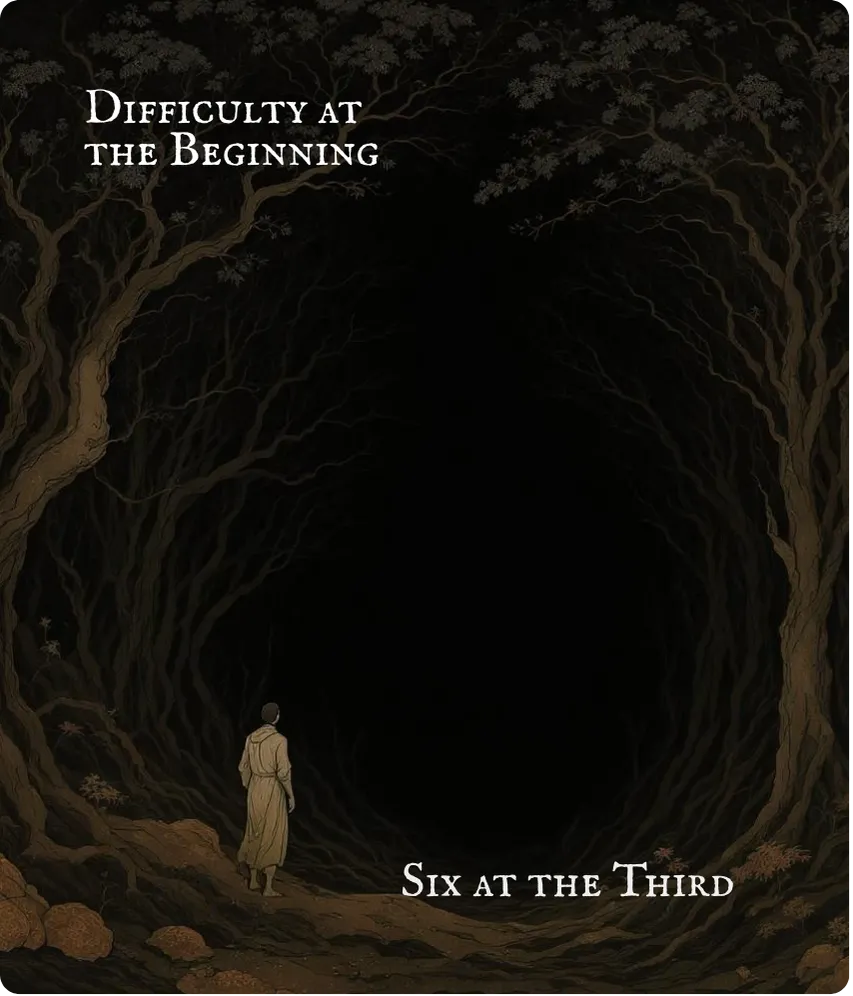

Hexagram 3 — Difficulty at the Beginning: Six in the Third Line Explained

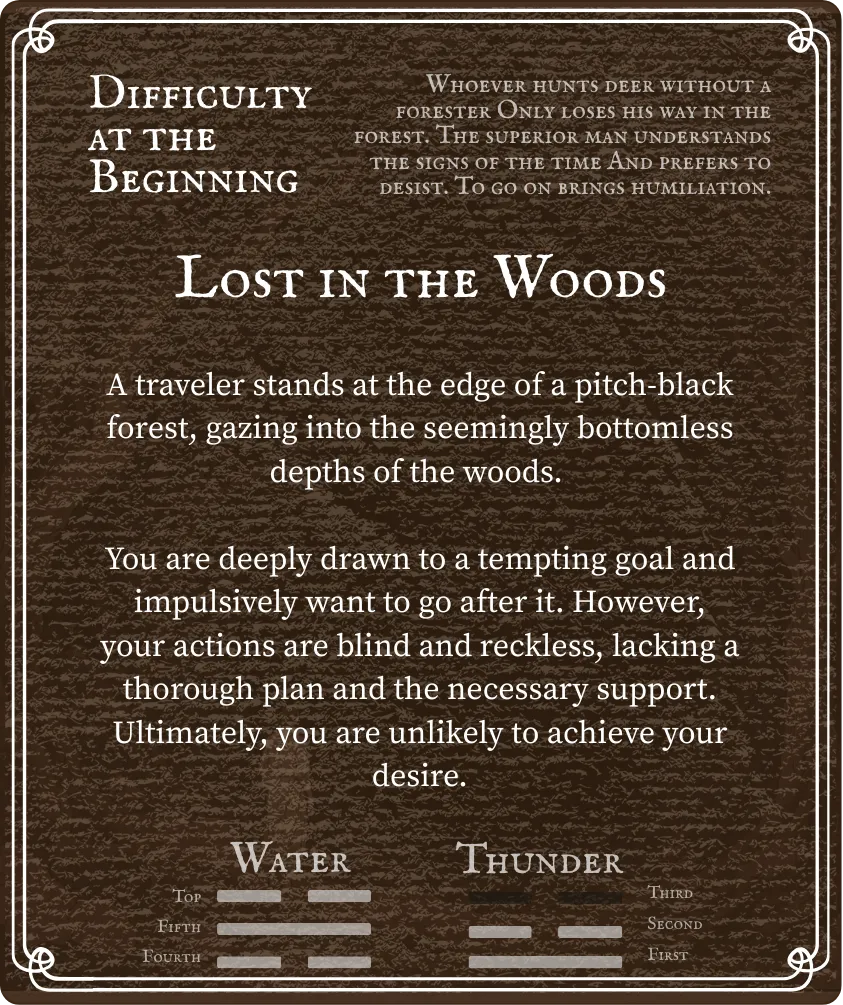
Six in the Third: Whoever hunts deer without the forester only loses his way in the forest. The superior person senses the situation and gives up. To go on brings humiliation. This line warns against reckless pursuit without preparation.

Yao Position Overview

Yao Text

Six in the Third: Whoever hunts deer without the forester only loses his way in the forest. The superior person, understanding the signs, prefers to desist. Going on leads to humiliation.

Tuan Commentary

The Tuan Commentary says: Difficulty at the Beginning — the firm and the yielding begin to interact, and difficulty is born. Movement amid danger leads to sublime success through perseverance. The movement of thunder and rain fills all things to overflowing. Heaven creates the primal chaos — it is fitting to appoint helpers, yet there shall be no rest.

Hexagram 3 Difficulty at the Beginning — Six in the Third Line Card

The Six in the Third is the third line of Hexagram 3 — a yin line at the top of the lower trigram. "Hunting deer" means pursuing game. "Without the forester" means lacking a guide who knows the terrain (in ancient China, the forester was the official who managed mountains and forests). "Only loses his way in the forest" means blundering alone into the deep woods. "The superior person, understanding the signs" means the wise person perceives the warning signs in time. "Prefers to desist" means it is better to give up entirely. "Going on leads to humiliation" means pressing forward will only bring disgrace and difficulty.

This line paints a vivid picture: a hunter spots his prey but, without a knowledgeable guide, charges blindly into dense forest — almost certainly getting lost and catching nothing. It is one of the I Ching's most classic teachings on "knowing when to stop." The wisdom here is that when conditions are not ripe — when you lack the knowledge, the connections, or the preparation — the bravest thing you can do is walk away.

Yilore Reading

Halting at the Forest's Edge

Hexagram 3 Difficulty at the Beginning — Six in the Third Line Front
Hexagram 3 Difficulty at the Beginning — Six in the Third Line Back

Yilore interprets the Six in the Third of Hexagram 3 as "the price of impulse." When this card appears, it delivers a clear warning: you are deeply attracted to some alluring goal or opportunity, and a powerful urge to pursue it is rising within you. But the problem is — you have no reliable guide (no forester), nor sufficient preparation or plan.

Like that traveler standing at the edge of a pitch-dark forest, unable to see the path ahead, yet driven by the lure of prey to charge in. The core counsel of this card is just four words: "better to let go." Giving up takes more courage than persisting. When conditions are not ripe, when the guide is absent, when the way ahead is unclear — to stop is the best form of progress. The truly wise person is not one who never gives up, but one who knows when it is time to let go.

Divination Insights

The Six in the Third line speaks to the theme of "reckless pursuit without support." You are strongly attracted to a certain goal, eager to act, but objective conditions are not yet ripe — you lack experience, guidance, and a solid plan. The overall tone: cool down, face reality, and recognize that when conditions are not met, giving up is wiser than charging ahead blindly.

Career

Six in the Third issues a strong "do not rush forward" warning for your career. You may have spotted a very attractive opportunity — a high-paying position, a fast-track promotion, or a seemingly lucrative startup project. But upon careful analysis, you'll find you lack the necessary industry experience (no forester), have no reliable network or resource support, and haven't adequately assessed the risks ahead. Charging in under these conditions will likely leave you lost in the "forest" — investing massive time and energy for minimal return. Three steps: first, find a reliable industry mentor or advisor; second, create a detailed action plan with risk contingencies; third, if neither of the above is possible, decisively abandon this opportunity and wait for a more mature moment.


Relationships

In love, Six in the Third warns against being swept away by momentary infatuation. You may be pursuing someone who seems incredibly attractive, but this relationship carries obvious uncertainty and risk — the other person's attitude is ambiguous, there's a significant gap in circumstances, or insurmountable practical obstacles exist. "Hunting without the forester" reminds you: in this relationship, you have no "guide" — no channel to truly understand the other person, no mutual friends to vouch for them, perhaps not even basic knowledge of their real situation. Continuing to invest emotionally under these conditions is likely one-sided. Cool down, assess rationally, and don't mistake fantasy for reality.

Wealth

Financially, Six in the Third is the clearest possible "do not invest" signal. A seemingly high-return investment opportunity may be tempting you — a high-yield financial product, a friend's "insider project," or a hot-sector startup opportunity. But you lack professional knowledge in this field (no forester) and haven't done thorough research. This is exactly like charging into the deep forest without a guide to hunt deer — you'll most likely get lost and come back empty-handed. Follow one iron rule: don't invest in what you don't understand, don't touch what you can't see clearly, don't participate in opportunities without professional vetting. At this stage, protecting your wallet matters far more than chasing profits.

Health

Health-wise, Six in the Third warns against overconfidence in your physical capabilities. You may be engaging in activities beyond your body's capacity — extreme workout regimens, radical diets, or chronic sleep deprivation. Like charging into the forest without a guide, health management without professional guidance can easily backfire. Find a reliable fitness trainer, nutritionist, or doctor (your "forester"), and develop a reasonable health plan under professional supervision. Balance work and rest, and don't ignore your body's warning signals in pursuit of some goal.

易羅 アプリのアイコン

Get the Yilore app

Full charts, daily hexagrams, and deeper AI readings on your phone.

App Store

FAQ

What does 'Whoever hunts deer without the forester only loses his way in the forest' mean?

"Hunting deer" means pursuing game. "The forester" was an ancient official who managed mountains and marshes — here it represents a guide or mentor. "Without the forester" means having no guide. "Only loses his way in the forest" means blundering alone into the deep woods. The full picture: a hunter spots prey (the deer) but, without a guide who knows the terrain, rashly charges into the dense forest — and will almost certainly get lost without catching anything. The concluding words — "the superior person, understanding the signs, prefers to desist; going on leads to humiliation" — summarize the lesson: the wise person recognizes the warning signs and stops; rather than pursuing blindly, it is better to give up decisively. Pressing forward will only lead to disgrace.

I received a changing Six in the Third — should I give up?

A changing Six in the Third does require you to seriously consider "giving up" as an option. But this "giving up" is not passive avoidance — it is an active strategic choice. You need to honestly answer three questions: first, how much do you truly understand about the goal you're pursuing? Second, do you have a reliable guide or advisor to direct you? Third, have you prepared a thorough plan and exit strategy? If all three answers are unsatisfactory, then "prefers to desist" is the wisest choice. Abandon this premature opportunity and instead seek a guide, accumulate knowledge, and develop a plan — when conditions are ripe, your chances of success will be much higher.

What does the Six in the Third of Hexagram 3 teach about investing and finance?

The Six in the Third's lesson for investing is extremely direct: do not invest in what you don't understand. "Hunting deer without the forester" perfectly describes the scenario — you spot the "prey" (a high-return investment opportunity) and excitedly want to chase it, but you have no "forester" (professional investment knowledge, reliable industry connections, in-depth research and analysis). Charging into the "forest" (committing funds) under these conditions will most likely result in getting lost and losing money. There's a famous investing maxim that echoes this: "Never invest in something you don't understand." If you truly believe in a certain direction, first spend time learning and researching, find a trustworthy professional advisor, and only act when you yourself have become the "forester."